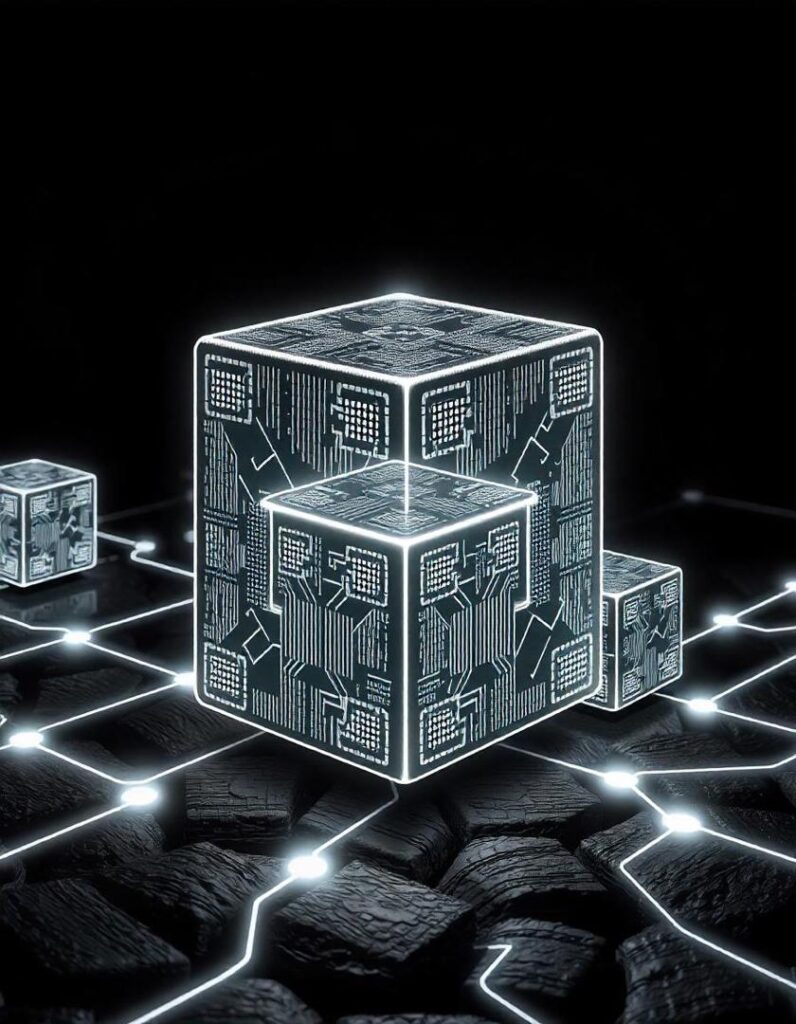
Now that you know the basics of blockchain, let’s focus on its essential components and how they contribute to the technology’s success. This will give you a deeper understanding of why blockchain is transforming industries worldwide.
- Blocks: The Foundation of Blockchain
A blockchain is made up of “blocks” that store information. Each block includes:
• Data: Information about transactions, such as the sender, receiver, and amount.
• Hash: A unique code (like a fingerprint) that identifies the block.
• Previous Hash: This connects the block to the one before it, forming a secure chain.
Real-Life Analogy: Think of each block as a sealed box containing transaction records. The box has a label (the hash) that links it to the previous box, creating a chain.
- Consensus Mechanisms: How the Network Agrees
Blockchain relies on consensus mechanisms to ensure that all participants agree on the validity of transactions. The most common methods are:
• Proof of Work (PoW): Computers solve complex puzzles to validate transactions and create new blocks (used in Bitcoin).
• Proof of Stake (PoS): Validators are chosen to add blocks based on the number of coins they hold and are willing to lock as collateral (used in Ethereum).
Example: In a voting system, either everyone casts a vote (PoW) or trusted representatives vote on behalf of the group (PoS).
- Decentralization: No Central Authority
Unlike traditional systems, blockchain operates on a decentralized network of computers (nodes). This means no single person or organization controls the system, making it:
• Resilient: If one part of the network fails, others keep running.
• Secure: Hacking the system would require attacking all nodes simultaneously.
Example: Think of a shared library where everyone keeps a copy of the books. If one copy is lost, others remain intact.
- Cryptography: Securing the Data
Blockchain uses cryptography to protect transactions and ensure data integrity.
• Every transaction is encrypted, making it accessible only to authorized parties.
• Once a block is added to the chain, it cannot be altered without changing every subsequent block.
Real-Life Analogy: It’s like locking a message in a box with a unique key. Only those with the key can access the message, and the lock cannot be tampered with.
- Applications of Blockchain Beyond Cryptocurrency
- Smart Contracts:
Blockchain enables automated agreements that execute when predefined conditions are met.
Example: A freelance contract where payment is released automatically when the project is completed. - Supply Chain Tracking:
Blockchain provides transparency in tracking goods from production to delivery.
Example: Tracking the origin of coffee beans to ensure they’re ethically sourced. - Digital Identity:
Blockchain can store and verify identities securely.
Example: Proving your age online without sharing your full ID. - Tokenized Assets:
Real-world assets like art, real estate, or music rights can be digitized as tokens for easier trade and ownership.
Example: Owning a share of a famous painting through blockchain.
- Smart Contracts:
Why Blockchain Matters
Blockchain is much more than a record-keeping system. It’s a tool for creating trust, improving efficiency, and reducing the need for intermediaries in countless industries. By understanding its components and applications, you’ll see how this technology is shaping the future of everything from finance to healthcare.